



Data centers contribute revenue to the electric system, and a portion of that revenue is shared with customers through approved rate mechanisms. Follow the journey of bringing a large customer online to see how.
The journey of customer benefits
How it works
A data center plugs into the MDU grid. The data center is responsible for purchasing their own energy from the market directly. Through approved rate mechanisms, a credit from revenue generated by the data center flows back across the entire customer base.

A large customer arrives
A single, large user of energy, like a data center, connects to the MDU electric grid.

Revenue is generated
The data center energy usage generates revenue across fuel, power and transmission costs.*

Spread through approved rates
A portion of revenue is returned to customers through fuel cost adjustments and transmission revenue mechanisms.

Credits land at home
The result is a measurable credit for other MDU customers.
*Fuel, power and transmission costs include the cost of resources to produce electricity, the cost to produce and purchase electricity, and the cost to move electricity across the grid.
Why this works
// 01
Data centers help spread fixed system costs across far more usage.
// 02
Their revenue helps offset the everyday expenses of running the grid.
// 03
Those benefits are returned to customers through approved rate designs.
All states are not equal
Each state regulates utilities differently, so the way data center revenue reaches customers takes a different shape in North Dakota, South Dakota and Montana. Large energy users like data centers do not increase customer rates. They pay their own costs and their usage helps offset costs for others.
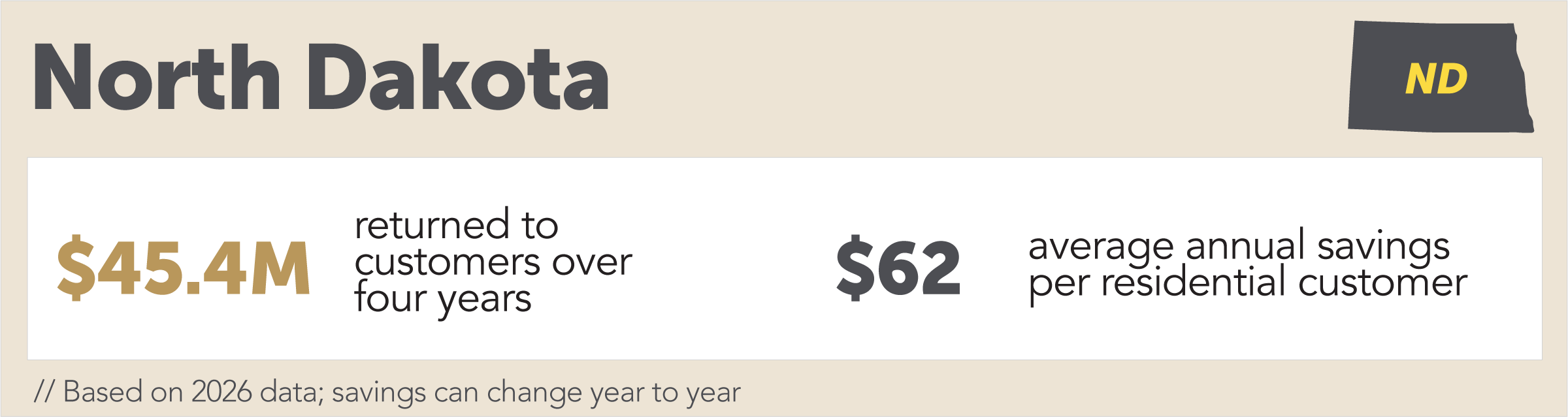
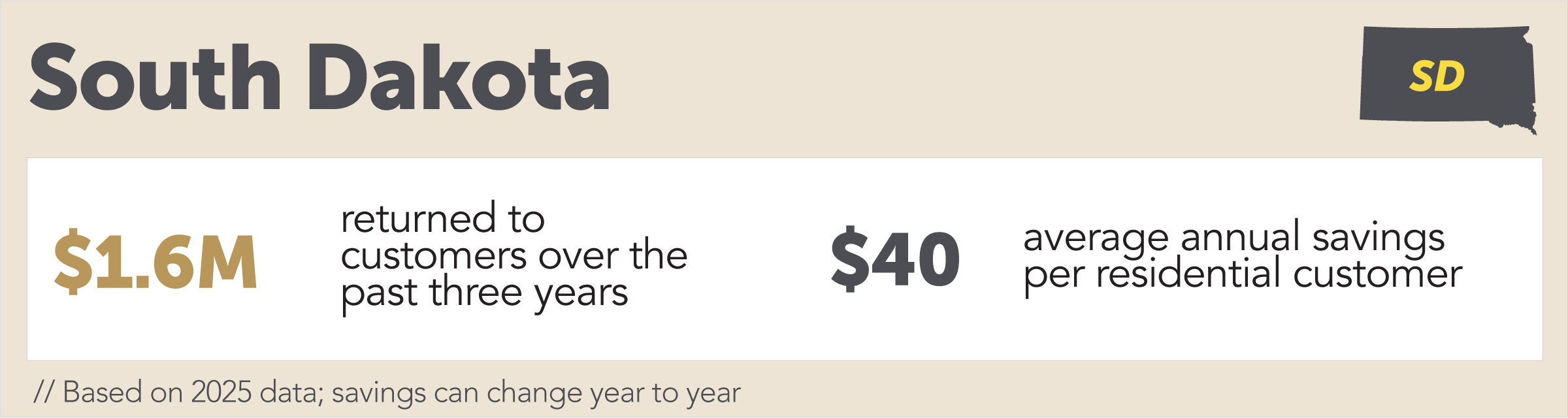
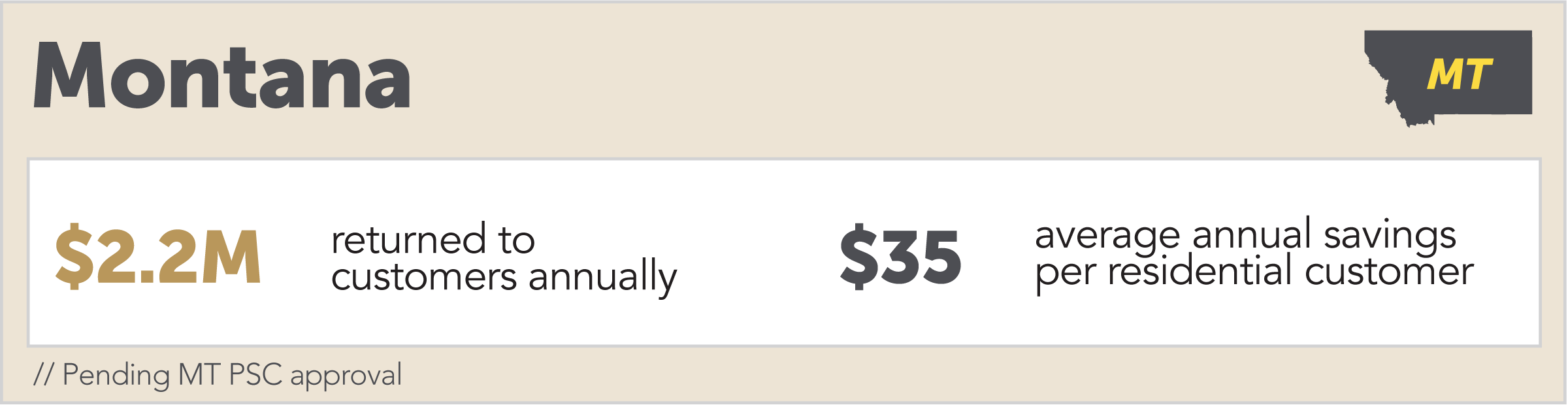
Savings vary by year based on usage, rates and regulatory mechanisms in each state. Unless otherwise noted, all figures reflect regulator-approved rate structures. Examples shown are averages; individual bills may vary.
Data Center FAQs
MDU evaluates whether and how it can safely and reliably provide electric service to large energy users, including data centers. MDU does not build, own or operate data centers. The company’s role is to review service requests, evaluate system impacts, determine infrastructure needs and complete the necessary engineering reviews and regulatory approvals before service can be provided.
Data centers are attracted to areas with available land, strong energy infrastructure, access to transmission, competitive energy costs and supportive communities. However, interest alone does not guarantee a project will move forward. Each proposal must be evaluated through engineering studies, contractual agreements and regulatory review.
No. MDU’s approach is designed to protect existing customers from costs associated with serving large-load customers. The company uses structured service agreements, regulatory oversight and cost-allocation mechanisms intended to ensure that customers who create the need for additional infrastructure or service requirements are responsible for those costs.
MDU follows the principle of cost causation, meaning the customer that creates a cost should pay that cost. Infrastructure and service costs that are specifically needed to serve a data center are assigned appropriately through contracts, tariffs and regulatory approvals. Benefits associated with these agreements may also flow back to customers through approved regulatory mechanisms.
Before service can be provided, MDU conducts detailed engineering and system studies to evaluate load requirements, timing, location and infrastructure needs. Depending on the project, additional reviews may include regulatory approvals, transmission studies, market impact analyses and public regulatory proceedings. These reviews help ensure that projects are evaluated from reliability, engineering, economic and customer-protection perspectives.
Large-load customers can provide benefits when projects are properly located, appropriately structured and supported by the electric system. Each project is evaluated individually to determine whether it can be served safely and reliably while protecting existing customers. Studies help determine infrastructure needs, market impacts and system capabilities before any service is approved.
Potential market impacts are analyzed as part of the evaluation process. For example, MDU has conducted market studies to assess whether specific projects would affect power costs for other customers. Rather than assuming all projects have the same impacts, MDU evaluates each project based on its location, size and operating characteristics.
Large-load service agreements are reviewed through applicable regulatory processes. Regulators evaluate whether proposed agreements and service arrangements are reasonable and in the public interest. Depending on the project, the process may include formal filings, commission review and opportunities for public participation.
Rate 45 is a specialized tariff approved in North Dakota and South Dakota for certain high-density data center customers. It applies to qualifying customers with large electric demands and includes provisions related to demand response and energy management. The tariff creates a framework tailored to the needs and characteristics of these large users rather than applying standard residential or small-business rate structures.
Data center service agreements and related arrangements are handled separately from general rate cases. General rate cases address the costs of providing safe and reliable utility service across the broader system, while large-load customers are generally served through separate agreements and regulatory mechanisms tailored to those projects.
No. Protecting reliability for existing customers is a key part of MDU’s evaluation process. Projects must undergo detailed studies before service is approved. Reliability considerations, infrastructure requirements and system impacts are analyzed to ensure existing customers continue to receive safe and reliable service.
No. Certain large-load customers may participate in demand response programs that allow them to reduce electricity use during periods of system stress or unusually high demand. Some facilities may also maintain backup generation resources. These provisions help support system reliability during emergency conditions.
No. Every project must be evaluated individually. Factors such as transmission capacity, generation availability, infrastructure requirements, permitting, regulatory approvals and overall system impacts determine whether a project can move forward. In some cases, additional infrastructure or other resources may be required before service can be provided.
Data center projects can contribute economic activity, tax revenue and local investment. Communities may use these revenues to support public services, infrastructure improvements and other local priorities. At the same time, MDU recognizes that each community is unique and that community input, landowner considerations and local impacts are important parts of the overall discussion.
MDU evaluates projects through engineering, regulatory and public-review processes. While MDU does not operate the data centers themselves, the company recognizes that community members may have questions related to land use, noise, water use and other local impacts. These topics are often considered through permitting, regulatory and local review processes involving multiple stakeholders.
MDU’s approach is guided by three principles: reliability, affordability and fairness. The company evaluates each opportunity carefully, studies its impacts, assigns costs appropriately and works through established regulatory processes before moving forward. The goal is to support responsible growth while continuing to protect existing customers and serve communities.
Many large-load projects are subject to regulatory proceedings that include public filings, commission review and opportunities for public input. Information may also be available through state regulatory agencies, project developers and local government entities involved in the review process.